SILENT HILL Townfall The CRTV Pocket Television
Townfall’s radio replacement — four uses, one analog object, no minimap.
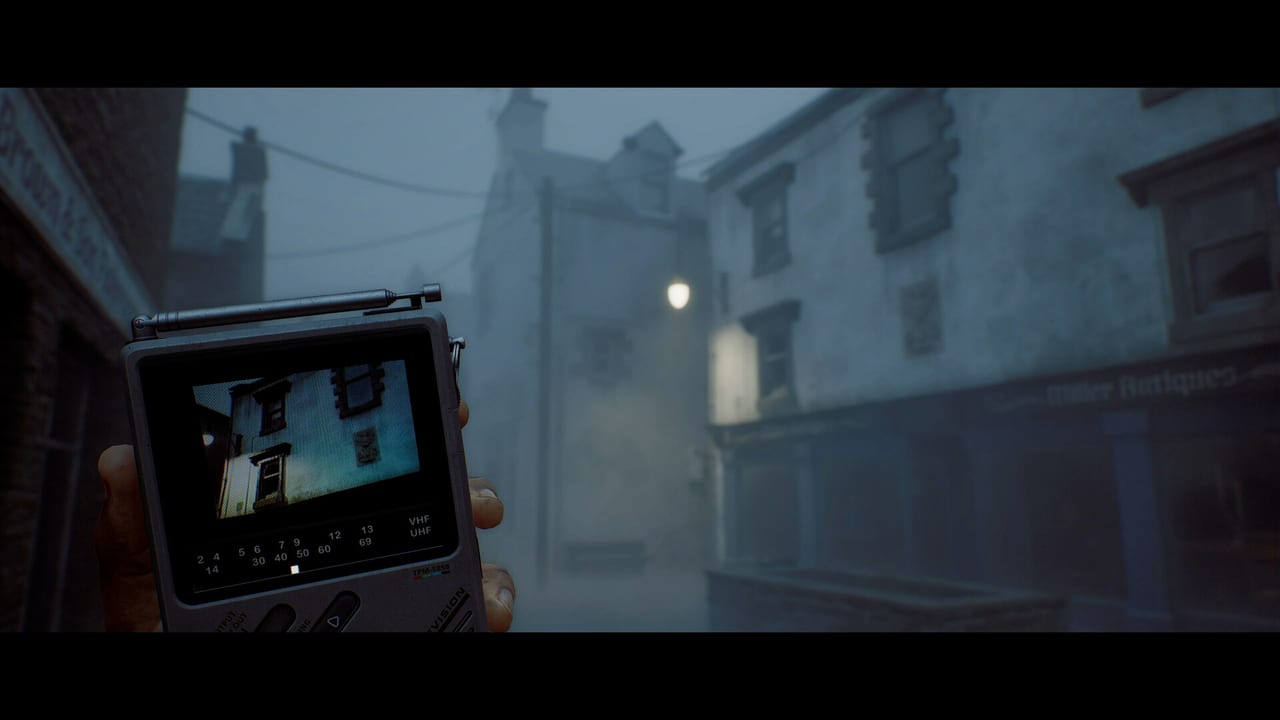
The CRTV is the reason SILENT HILL: Townfall is first-person. Screen Burn Interactive — the Glasgow studio formerly called No Code — built a pocket cathode-ray television that Simon Ordell actually raises into frame. It is not a corner widget. If the screen floated as a HUD, the object would stop being a 1996 Watchman and start being a radar. Inside Screen Burn Part 1, on this page, is Jon McKellan saying that out loud: the CRTV could not work from any other camera.
The studio name is the same joke as the hardware. Screen burn is what happens when a CRT holds one image too long. Townfall wants you to stare at unstable analog video until the town’s past burns in. Footage on the device is not a shader trick. The team ran gameplay and cutscenes through real pocket TVs, damaged cables, and magnets, then put that capture back into Unreal Engine 5. What you see on the glass is analog dirt.
You find the set in the opening, after Simon is pulled from the docks into a red-lit structure and, impossibly, into an apartment that has been used like a quarantine room. The handheld TV is waiting there. From that moment the campaign is a tuning problem as much as a walking problem. For the room-by-room opening, use the Shorefront walkthrough. This page is the device itself.
Four jobs, one dial
Enemy outlines. Classic Silent Hill radios hissed when something was near. The CRTV still hisses, then goes further: tune a threat frequency and silhouettes print through fog, plaster, and closed doors. You see a shape in the snow, not a health bar. Spend too long staring at the glass and a creature will walk into your shoulder. The CRTV is a peek you can take without leaning — pair it with the real peek on controls.
Narrative transmissions. Zoe’s voice, Richard’s summons, fragments of St. Amelia that do not belong on a street. Signals lock into the set once you catch them, so you can flip between saved clips instead of hunting the same frequency twice. The woman on the glass is not a quest marker. She is asking Simon to come back and put things right. Treat every clip as evidence, then read Zoe when you want the person, not the static.
Puzzle cues. Jon McKellan has said the puzzles are story. A loop of images on the CRTV is often the combination, the object, or the room you have not understood yet. Radios around town exist so you can calibrate the set against them — twist for a weak signal, then tap L1 and R1 to slide RGB channels into line. Details live on narrative puzzle tips. If a room refuses to open, the answer is probably already on the glass.
Distraction broadcast. Optional, and easy to waste. You can push noise out of the CRTV to pull a creature off a corridor the way you would smash a bottle. It is loud. It is not stealth. Use it when a hallway has one exit and a plank will not last the fight. Do not broadcast next to a closet you still need.
Why first-person is not a gimmick
A third-person Harry or James could wear a radio on a strap and keep both hands free. Simon has to lift the CRTV to his face. That costs field of view. Off-screen space is the horror; the pocket screen is the concession Screen Burn gives you in return. Peek (L1) restores a slice of the old over-the-shoulder information without turning the camera into a drone.
Because the set is an object, DualSense gyro is the honest control. Twist the pad the way you would twist a real tuner toward a window. Motion is optional — see controls — but the intended loop is physical. Adaptive triggers and haptics do not drive the CRTV; they tell you when something is walking while your eyes are on the snow.
How to actually use it in fog
Raise the CRTV before you round a Shorefront corner, not after you hear wet feet. Scan, drop it, peek, then move. If the silhouette is facing you, do not walk. If it is facing a garden fence, you have a window. Hide in a closet or a half-open door and watch the glass until the shape leaves; the set is how you know a chase is over without cracking the door.
On the street, follow static the way Game Informer’s preview described: the CRTV behaves like a compass toward the next house. That is how Simon finds Zoe’s place. Lock the clip, walk until the image and the architecture agree, then put the TV away so you can see curbs. Getting lost in the snow on the screen is how you walk into a blade.
Inside, the job changes. You are matching a transmission to a room: a nurse’s badge, a wrong dosage, a stethoscope that cannot hear. The puzzles page unpacks those objects. Do not skip signals because they look like flavour. In Townfall the flavour is the lock.
What the CRTV is not
It is not a map. The paper map is a separate, flippable item. It is not a weapon. Broadcasting noise is bait, not damage. It is not a pause. Time still moves while you stare. Japanese preview coverage called the signal unstable on purpose — 3 or 4 revolver rounds, 4 or 5 hits to drop Simon, and a TV that will not give you a clean picture. The scarcity is the design.
Pre-order skins (Rusted on all platforms, Beach Edition on PS5) change the shell, not the functions. Deluxe extras do not add channels. If a site promised “CRTV codes,” it was looking at a different product. Townfall is a single-player retail game with no gift-code layer.
Keep the set in your hand the way Screen Burn named themselves: long enough for the image to stick, not so long that the hallway behind you burns you instead. When the picture finally makes sense, the street still has to be walked.
Frequently Asked Questions
Quick answers for launch week and first-person survival.
Where do you find the CRTV?
In the opening, after Simon leaves the docks for a red-lit structure and arrives in an apartment used like a quarantine room. The walkthrough covers that stretch without ending spoilers.
What are the four CRTV uses?
Enemy silhouettes through fog and walls, narrative transmissions, puzzle cues, and an optional noise broadcast that lures creatures. You will not need all four in every room.
Why is Townfall first-person?
So the pocket TV is an object in Simon’s hands, not a minimap. Screen Burn’s Inside Part 1 video on this page is the studio saying the CRTV could not work from third-person.
Does the studio name relate to the CRTV?
Yes. Screen Burn is CRT burn-in: an image held too long on analog glass. The team ran real damaged televisions to capture the static you see in-game.
Can I play without gyro tuning?
Yes. Motion is optional. Sticks still tune; L1 and R1 still align RGB on radio puzzles. Gyro is the intended feel, not a gate. See controls.